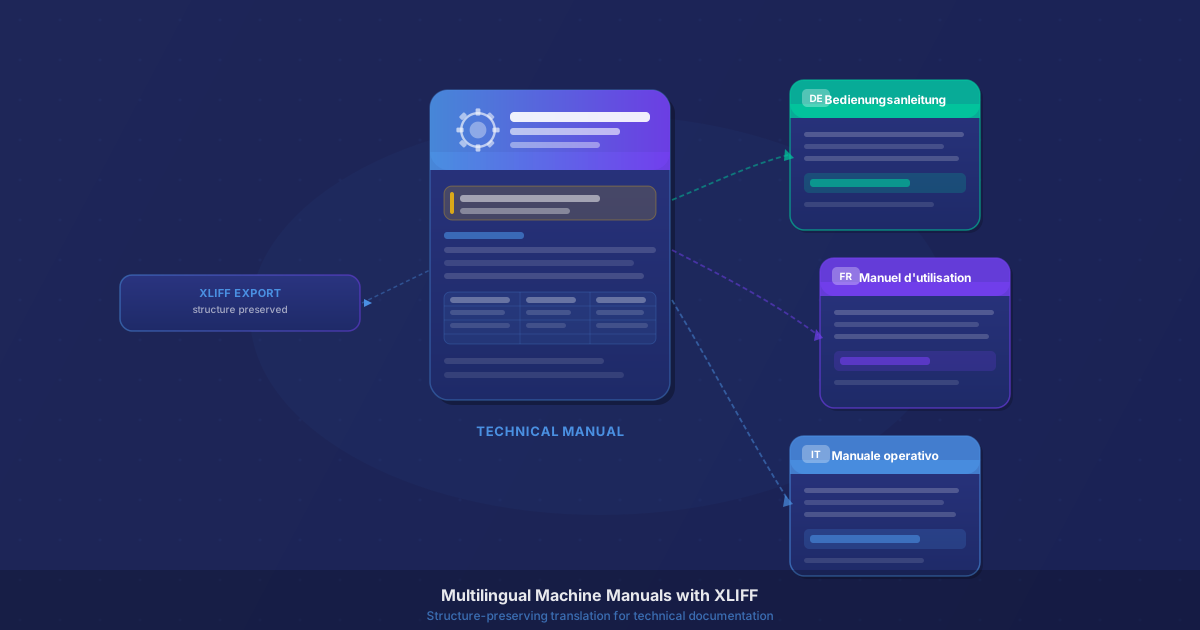
If your company builds machines, equipment, or industrial products for international markets, you already know the challenge: your product manual needs to be in the customer's language before the machine leaves your facility.
This is not just good practice. For products sold in the European Union, it is a legal requirement.
Why machine-building companies must provide translated manuals
The EU Machinery Directive (2006/42/EC), which currently governs machinery placed on the EU market, requires that instructions for machinery be provided in the official language or languages of the country where the machine is used. This requirement covers all machinery within the scope of the directive, including industrial equipment, production machines, and complex assembly systems.
The upcoming EU Machinery Regulation (EU) 2023/1230, which will replace the current directive and apply from January 20, 2027, maintains this language requirement and extends it to a broader range of equipment.
In practical terms: if you sell a machine to a German buyer, the manual must be in German. If you sell the same machine in France and Italy, you need French and Italian versions. If you serve ten markets, you may need ten versions of every manual.
Important note: This article summarizes the general language requirements under EU machinery legislation as commonly understood in the industry. Every company's situation is different. Always verify your specific obligations with a qualified legal advisor familiar with product compliance in your markets.
Beyond legal compliance, translated manuals matter for safety. Operators who cannot read the language of a manual cannot follow safety instructions. A machine that is misused because the instructions were unclear can cause accidents, product liability claims, and reputational damage.
The real challenge: manuals are not simple documents
A typical product manual for industrial machinery is not a two-page brochure. It might be 200 or 400 pages long, structured across dozens of chapters, with:
- Safety warnings and hazard symbols that must appear exactly as designed
- Numbered procedures that must stay in precise order
- Tables with technical specifications
- Cross-references between sections
- Variable text like model numbers, part IDs, and voltage specifications
- Index entries, glossaries, and legal notices
These documents are usually created in professional authoring tools, software specifically designed for structured technical content. Adobe FrameMaker is one of the most widely used tools in this category, particularly in manufacturing, engineering, and technical publishing.
The problem is that this rich structure makes translation complicated. You cannot simply copy the text out, send it to a translator, and paste it back. The formatting will break. The cross-references will stop working. The structure will be lost.
This is where XLIFF makes a genuine difference.
How XLIFF fits into a machine manual translation workflow
XLIFF is an open standard format for exchanging translatable content. When your authoring tool exports your manual as XLIFF, what happens is this:
Your authoring tool reads through the structured document and extracts every piece of text that a translator needs to work on. It wraps each piece in a translation unit, a container that carries the original text (the source) and leaves a space for the translated text (the target). Any formatting codes, variable references, or structural markers are preserved as placeholder elements inside the translation unit, so translators can see them without touching them.
The result is an XLIFF file. It looks nothing like your original manual. It is a clean, structured exchange file containing only translatable content, plus just enough structural information to put everything back in the right place when translation is done.
Your translator receives the XLIFF file and works on it using professional translation software (called a CAT tool). They never touch your original FrameMaker files, your XML structure, or your document templates. They simply work text-by-text through the translation units.
When they are finished, they send the XLIFF file back. Your authoring tool imports the translated XLIFF and rebuilds the document in the target language. The result is a complete translated manual with the same structure, formatting, tables, and cross-references as the original, in the target language.
The practical benefits for machine builders
You do not need to send your original files to translators. This is a real concern for many manufacturers, especially those working with sensitive technical drawings or proprietary product data. The XLIFF file contains only the translatable text, not your templates, your design files, or your authoring tool's proprietary format.
Translation memory reduces costs over time. Every sentence a translator approves is stored in a translation memory database. When you release a new version of the product or update the manual, only the changed segments need to be translated again. Unchanged paragraphs, such as safety instructions, general operating procedures, and standard warnings, are reused automatically. For companies that update manuals regularly, this saves significant time and money.
Multiple translators can work in parallel. XLIFF files can be split into smaller packages, allowing different translators to work on different sections simultaneously. A 400-page manual that might take six weeks with a sequential approach can be completed in a fraction of the time when work is distributed in parallel.
Terminology stays consistent across languages. Translators working with CAT tools can access shared glossaries and terminology databases while they translate. Product names, component labels, safety terms, and technical specifications are translated consistently across the entire manual and across all language versions, not just within one document but across your entire product range.
No manual reformatting after translation. When translation is done, the document rebuilds itself. You do not need a typesetter or a layout specialist to put the translated text back into the document. The structure is preserved automatically, which means shorter turnaround times and lower production costs for each language.
Adapting to a new product version is much faster. When a machine is updated, the manual changes too. With a traditional copy-paste approach, every language version has to be updated by hand. With an XLIFF workflow, you export the updated content, compare it against previous translation memories, translate only the changed segments, and reimport. For a machine that sees regular updates, this is a major operational advantage.
What this looks like in practice
Imagine a manufacturer of packaging machinery based in Germany. They sell their products in twelve countries. Each product ships with a 300-page operating and maintenance manual.
Without an XLIFF workflow, their process might look like this: a technical writer finishes the manual in German, then hands a Word export to twelve different freelance translators, who each produce a translated Word document, which then has to be manually reformatted back into the original document design for each language. Every product update starts the whole cycle again.
With an XLIFF workflow, the process changes significantly. The technical writer creates the manual in FrameMaker or a similar tool. When the manual is ready, they export it as XLIFF. The XLIFF package goes to a translation management system or directly to translation agencies. Each translator works in their CAT tool. Translation memories from previous manual versions automatically fill in unchanged content. New or changed segments are the only ones that need to go through full translation. The translated XLIFF files come back, are imported into the authoring tool, and twelve language versions of the manual are available within days, not weeks.
Getting started does not require a complete process overhaul
You do not need to rebuild your entire documentation workflow to benefit from XLIFF. If you already use Adobe FrameMaker, Arbortext, MadCap Flare, Paligo, or similar authoring tools, you likely have XLIFF export capability already built in.
The most practical starting point is to:
- Identify which authoring tool creates your manuals
- Check whether it supports XLIFF export (most professional tools do)
- Find a translation partner or service that accepts XLIFF input
- Run a pilot with one manual in one target language
Even for teams that are not using a professional authoring tool yet, modern translation services, including AI-powered options, can work with XLIFF files and help you transition from a copy-paste workflow to a structured one.
The investment in a proper XLIFF-based process pays back quickly. For any company shipping machines to international markets, the combination of legal compliance, safety, quality, and operational efficiency makes structured translation not just a best practice, but a business necessity.
Working with XLIFF files right now? Upload your file to AI-DocTranslate and get a professionally structured translated output in minutes. Also read: What Is XLIFF and What Is It Usually Used For?